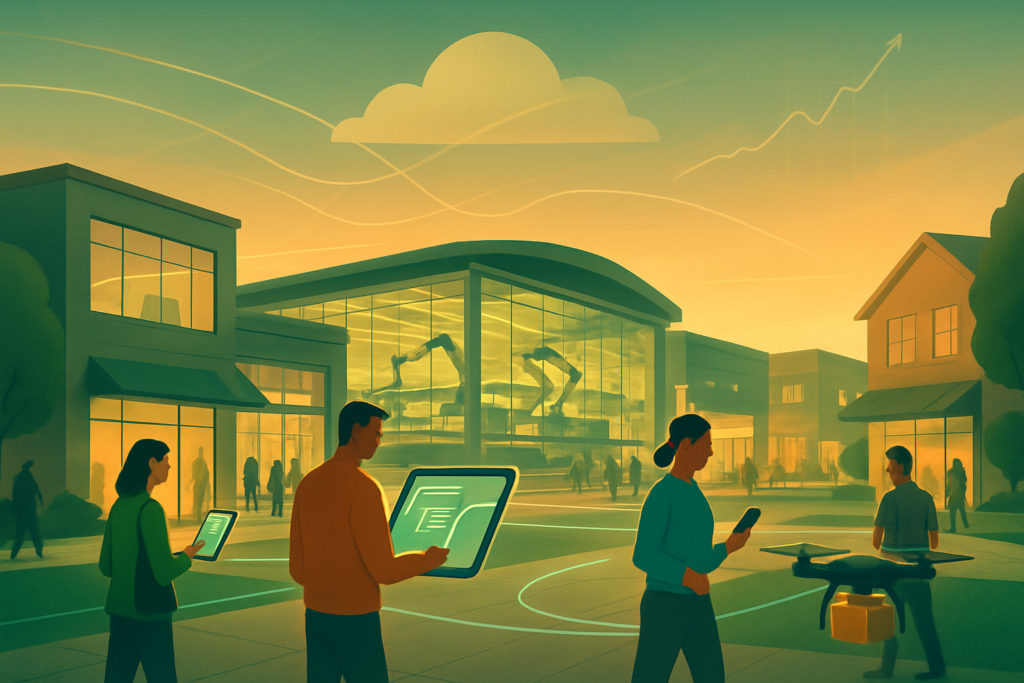
As of April 3, 2026, Walmart Inc. (WMT: NYSE) stands not merely as the world’s largest brick-and-mortar retailer, but as a sophisticated, tech-powered ecosystem that has fundamentally redefined the "big box" paradigm. Long regarded as a defensive value play for conservative portfolios, Walmart has spent the last decade aggressively pivoting toward an omnichannel model that blends its massive physical footprint with high-margin digital services. This transformation reached a symbolic peak in January 2026 when the company transitioned its primary listing from the New York Stock Exchange to the Nasdaq-100—a move reflecting its arrival as a technology leader alongside giants like Amazon and Alphabet.
Historical Background
Founded in 1962 by Sam Walton in Bentonville, Arkansas, Walmart’s early mission was simple: provide the lowest prices to rural communities that were often overlooked by major department stores. The company’s growth was fueled by a relentless focus on supply chain efficiency and a "Every Day Low Price" (EDLP) philosophy. By the 1990s, Walmart became the largest retailer in the world, expanding into urban markets and launching Sam’s Club to compete in the warehouse segment.
The most critical transformation in recent history began around 2014 under the leadership of Doug McMillon. Recognizing the existential threat posed by e-commerce, Walmart acquired Jet.com in 2016 for $3.3 billion, an acquisition that served as a Trojan horse for digital talent. Over the next decade, the company integrated its stores and websites, invested billions in supply chain automation, and launched Walmart+, marking its evolution from a product-focused retailer to a service-oriented platform.
Business Model
Walmart’s business model has evolved into what analysts call an "alternative profit flywheel." While the core of the business remains retail—selling groceries, apparel, and electronics—the profit growth is increasingly driven by high-margin ancillary services.
- Walmart U.S.: The largest segment, accounting for the majority of revenue. It encompasses Supercenters, Discount Stores, and Neighborhood Markets.
- Walmart International: Operates in 19 countries, including significant investments in India (Flipkart and PhonePe) and Mexico (Walmex).
- Sam’s Club: A membership-only warehouse club that provides a recurring revenue stream through fees and serves both residential and small business customers.
- Walmart Connect: The company’s advertising arm, which leverages first-party shopper data to allow brands to target customers across digital and physical touchpoints. This segment now contributes a disproportionate share of operating income growth.
Stock Performance Overview
The last decade has been a period of significant "re-rating" for WMT shares. Over the 10-year period ending in early 2026, the stock delivered a total return of approximately 550%, vastly outperforming the S&P 500.
- 1-Year Performance: In 2025, the stock benefited from a flight to quality as inflation-weary consumers shifted their spending toward Walmart’s value-oriented grocery segment. Shares rose roughly 22% over the trailing 12 months.
- 5-Year Performance: Since 2021, the stock has nearly doubled, driven by the successful scaling of e-commerce and the 3-for-1 stock split in February 2024, which enhanced liquidity for retail investors.
- 10-Year Performance: The stock hit an all-time high of $133.62 in February 2026, reflecting the market’s recognition of Walmart’s improved margin profile and its dominance in the digital grocery space.
Financial Performance
In the fiscal year 2026 (ended January 31, 2026), Walmart reported a blockbuster set of results.
- Total Revenue: $713.2 billion, up 4.7% year-over-year.
- Net Income: $21.89 billion.
- Profitability Mix: Advertising and membership fees together accounted for roughly one-third of total operating income by the end of FY2026.
- E-commerce: Global e-commerce sales grew by 27%, crossing the $100 billion threshold for the first time in a single fiscal year.
- Capital Allocation: In February 2026, the board announced a new $30 billion share buyback authorization, demonstrating confidence in its cash flow generation.
Leadership and Management
A major transition occurred on February 1, 2026, when long-time CEO Doug McMillon retired after 12 years at the helm. McMillon is credited with navigating the "Amazon threat" and modernizing the company’s tech stack.
He was succeeded by John Furner, a 32-year Walmart veteran who previously served as the CEO of Walmart U.S. Furner’s strategy is built on the concept of "people-led, tech-powered" retail. He is supported by Chief Growth Officer Seth Dallaire, who is tasked with expanding the advertising and data monetization segments. The leadership transition has been smooth, with Furner continuing the focus on supply chain automation and market share gains in the high-income demographic ($100,000+ household income).
Products, Services, and Innovations
Innovation at Walmart is now focused on "frictionless" shopping and AI integration.
- Sparky & Marty: In late 2025, Walmart scaled "Sparky," an AI shopping assistant that manages complex customer queries and reorders. For advertisers, "Marty" is an AI tool launched in early 2026 that automates bid strategies for Walmart Connect.
- Supply Chain Automation: Over 60% of U.S. stores are now serviced by automated Regional Distribution Centers (RDCs) powered by Symbotic. This has drastically reduced "out-of-stock" events and lowered fulfillment costs.
- Healthcare Pivot: After shuttering its physical clinics in 2024, the company launched "Better Care Services" in early 2026—a digital health platform that integrates telehealth, pharmacy fulfillment, and AI-driven nutrition advice.
Competitive Landscape
Walmart remains the undisputed leader in physical retail, but its competitive set has expanded.
- Amazon (AMZN: NASDAQ): While Amazon dominates pure e-commerce, Walmart’s "hub-and-spoke" model (using stores as fulfillment centers) gives it a cost advantage in fresh grocery delivery.
- Costco (COST: NASDAQ): Competes heavily with Sam’s Club. While Costco has superior member loyalty, Sam’s Club has closed the gap via superior mobile tech like "Scan & Go."
- Target (TGT: NYSE): Walmart has successfully lured Target’s traditional demographic by improving its apparel and home decor offerings while maintaining a lower price point on staples.
Industry and Market Trends
Retail is currently defined by three macro drivers: the "flight to value," the "digitalization of grocery," and "supply chain resilience." Walmart has capitalized on all three. Specifically, the shift toward private-label brands (like Great Value) has accelerated as consumers seek to combat persistent price pressures in the broader economy. Additionally, the integration of generative AI into search has moved the industry from "keyword search" to "intent-based discovery," a field where Walmart’s rich first-party data gives it an edge.
Risks and Challenges
Despite its dominance, Walmart faces several headwinds:
- Labor Costs: Persistent wage pressure and a competitive labor market remain the largest operational expense.
- Shrinkage: While AI-monitored self-checkouts have helped, retail theft and inventory "shrink" continue to weigh on margins.
- International Volatility: Geopolitical tensions and regulatory hurdles in key growth markets like India and China create uncertainty for the Walmart International segment.
- Data Privacy: As Walmart Connect grows, the company faces increased scrutiny over how it handles consumer data for targeted advertising.
Opportunities and Catalysts
- Walmart Connect Scaling: Advertising margins are significantly higher than retail margins. If Walmart can continue to capture ad spend from traditional TV and search, its consolidated margins will expand.
- High-Income Capture: In FY2025, households earning over $100k drove 75% of Walmart’s market share gains. Sustaining this "wealthy shopper" momentum is a massive growth lever.
- Automation ROI: As the full rollout of automated distribution centers completes by 2027, the resulting reduction in labor and logistics costs could drive a multi-year earnings expansion.
Investor Sentiment and Analyst Coverage
Wall Street remains overwhelmingly bullish on WMT. Following its move to the Nasdaq-100 in early 2026, the stock saw over $19 billion in passive capital inflows from index-tracking funds. Current analyst ratings show a "Strong Buy" consensus, with price targets ranging from $145 to $160. Hedge funds have also increased their positions, viewing Walmart as a rare "all-weather" stock that performs well in both inflationary and recessionary environments.
Regulatory, Policy, and Geopolitical Factors
Regulatory oversight is increasing, particularly from the FTC regarding the company’s retail media network and potential antitrust concerns in the digital grocery space. Furthermore, Walmart’s extensive global supply chain makes it sensitive to trade policy shifts between the U.S. and China. On the domestic front, the company continues to lobby for labor laws that provide flexibility for gig-economy drivers who power its "Spark" delivery network.
Conclusion
As of April 2026, Walmart Inc. has successfully completed its transformation from a legacy retailer into a modern, data-driven platform. By leveraging its stores as logistics hubs and its data as a media asset, the company has insulated itself against the purely digital threat of Amazon while capturing a larger share of the affluent consumer's wallet.
Investors should monitor the new CEO John Furner’s ability to maintain McMillon’s tech momentum and the continued scaling of Walmart Connect. While the stock's valuation is higher than historical norms, its improved margin profile and dominant position in the "new retail" landscape suggest it remains a foundational holding for growth-and-income investors alike.
This content is intended for informational purposes only and is not financial advice.